
Quoting A Job Nobody Can See Yet
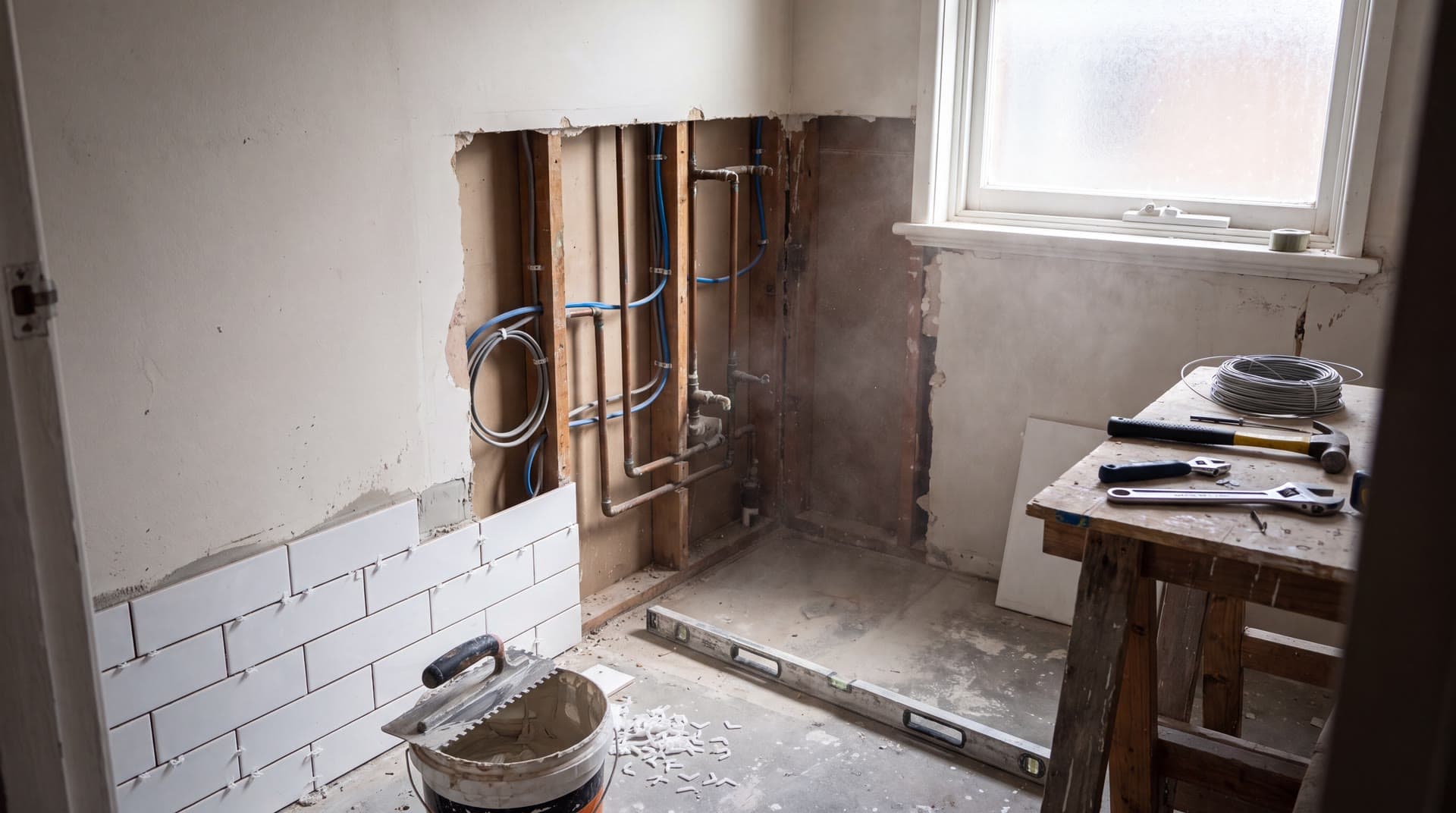
A leak behind a wall has an unknown cause, an unknown extent and an unknown number of trades attached to it.
Which means any number given before the wall is opened is an estimate dressed up as a quote. And the gap between that number and the real one is where most of the friction in maintenance comes from.
Why the surface tells you so little
The visible symptom and the actual fault are frequently in different places and different trades.
A stain on a ceiling can be a roof, a balcony membrane, a pipe in the floor above, a condensate line or a shower that was never waterproofed. Each of those is a different repair at a different cost, and the stain looks identical in all five cases. That diagnostic problem is the whole of [water coming through a ceiling in an apartment](/blog/water-coming-through-a-ceiling-in-an-apartment).
Then there is what gets found on the way: sheeting that has to be identified before it can be cut, as in [asbestos in older buildings and what stops a job](/blog/asbestos-in-older-buildings-and-what-stops-a-job); timber that has gone, as in [sub floor ventilation and timber rot](/blog/sub-floor-ventilation-and-timber-rot); or an electrical run exactly where the plumbing has to go.
The scoping visit
The useful answer is to price the investigation separately from the repair.
A scoping visit is a short, priced attendance with one purpose: establish what the fault actually is and what it will take. It produces four things.
A diagnosis, with the evidence for it. Moisture readings, a camera in the drain, a thermal image, or a small inspection opening in a position chosen so it is easy to make good.
A photographic record of what was found, which is what justifies the scope to an owner, an owners corporation or an insurer. That is the point of [the photo report and why it settles arguments](/blog/the-photo-report-and-why-it-settles-arguments).
A firm price for the repair, because the unknown is now known.
The sequence and the trades involved, so the access and the notice can be arranged once rather than three times.
Which turns one uncertain number into two certain ones, and the second is a price somebody can approve without a conversation about variations.
When a provisional sum is the right answer
Some jobs cannot be fully scoped even after an opening, because the extent is only revealed as the work proceeds. Water damage behind tiles is the common case.
For those, the honest structure is a firm price for the known work and a stated rate for the unknown portion, with a cap and a hold point. The work stops at the hold point, the condition is photographed, and the next step is approved before it happens.
That is different from an open ended job, because the client knows the maximum and sees the evidence at the decision point.
What a quote has to say to be useful
What is included, in countable terms. The repair, the making good, the paint, the rubbish removal, the number of attendances.
What is not included, explicitly. The sentence that prevents almost every dispute is the one that says what the price does not cover.
The assumptions it rests on, stated. Access available on the day, power and water available, the fault being the one diagnosed, no asbestos present.
What happens if an assumption fails, so the mechanism for a change is agreed before it is needed rather than negotiated after.
A quote with those four sections is longer and it is the one that gets approved and paid without argument.
Where the cost actually sits
On most hidden repairs, the repair is the smaller half.
The making good is the larger half, and it crosses trades: the wall sheeted and set, the tiles matched, the paint cut in, the skirting replaced. That is the pattern in [plaster repair after a water leak](/blog/plaster-repair-after-a-water-leak) and [skirtings, architraves and the damage that shows](/blog/skirtings-architraves-and-the-damage-that-shows).
Which is why a price that covers only the plumbing is not a price for the job, and why a quote from a single trade on a job that needs four is always going to grow.
One team scoping the whole sequence gives one number that includes the finish, and the client is comparing a complete piece of work rather than the first part of one.
For insurance work
The scoping visit is the document the insurer needs.
Cause of loss, evidence, extent, and a scope that separates the damage from the pre-existing condition. A claim lodged without that gets scoped by somebody who never saw the property, which is how the shortfall in [insurance repairs and the scope that gets missed](/blog/insurance-repairs-and-the-scope-that-gets-missed) happens.
Related Articles
Tell us about your building.
We will respond with a clear understanding of how we can help.
Get in Touch